A. Vicente Arévalo
  • About
  • Work
  • CV
  • GitHub

Work

Four research threads, seven refereed papers explained in plain English, three codes and a handful of talks — all on one question: what polarised spectra can honestly say about the magnetic field.
Work

Given polarised spectra, what can honestly be said about the magnetic field — and what cannot.

The through-line is inference. Everything below — four research threads, seven papers, three codes and a handful of talks — is a different angle on that one question.

ResearchPapersSoftwareTalks

Four threads

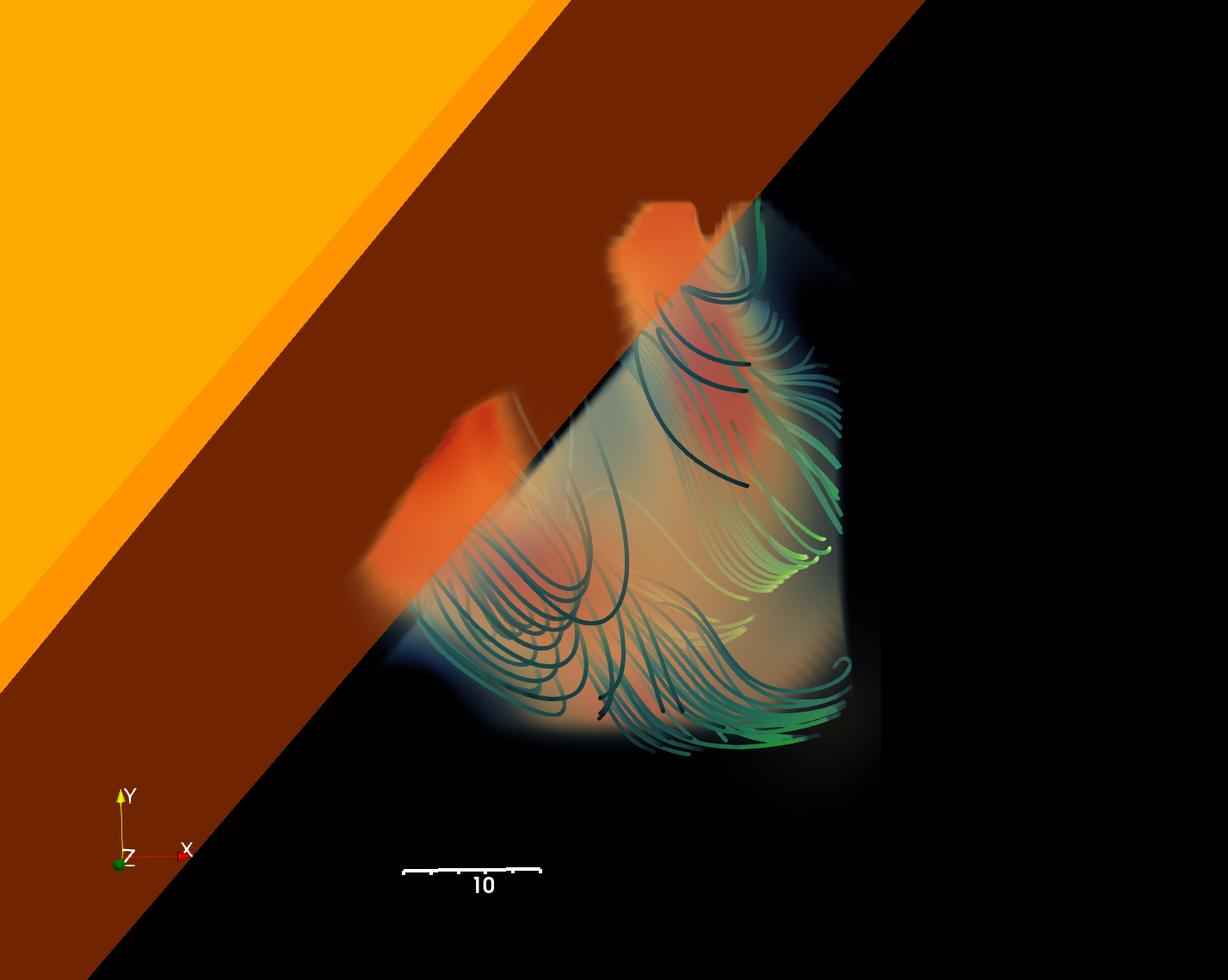
ParaView render of the POLARIS reconstruction: two dense orange feet joined by fainter plasma, threaded by green magnetic-field lines, beside the solar limb.
3D inference
Three-dimensional non-LTE inversions

Plane-parallel slabs discard the radiative transfer that carries depth information and leave a 180° azimuth ambiguity no data quality can fix. POLARIS treats level populations and the radiation field as free parameters inside one global minimisation, which makes a fully 3D inversion affordable.
POLARIS · VTT He I 10830 Å · In preparation (ApJL)
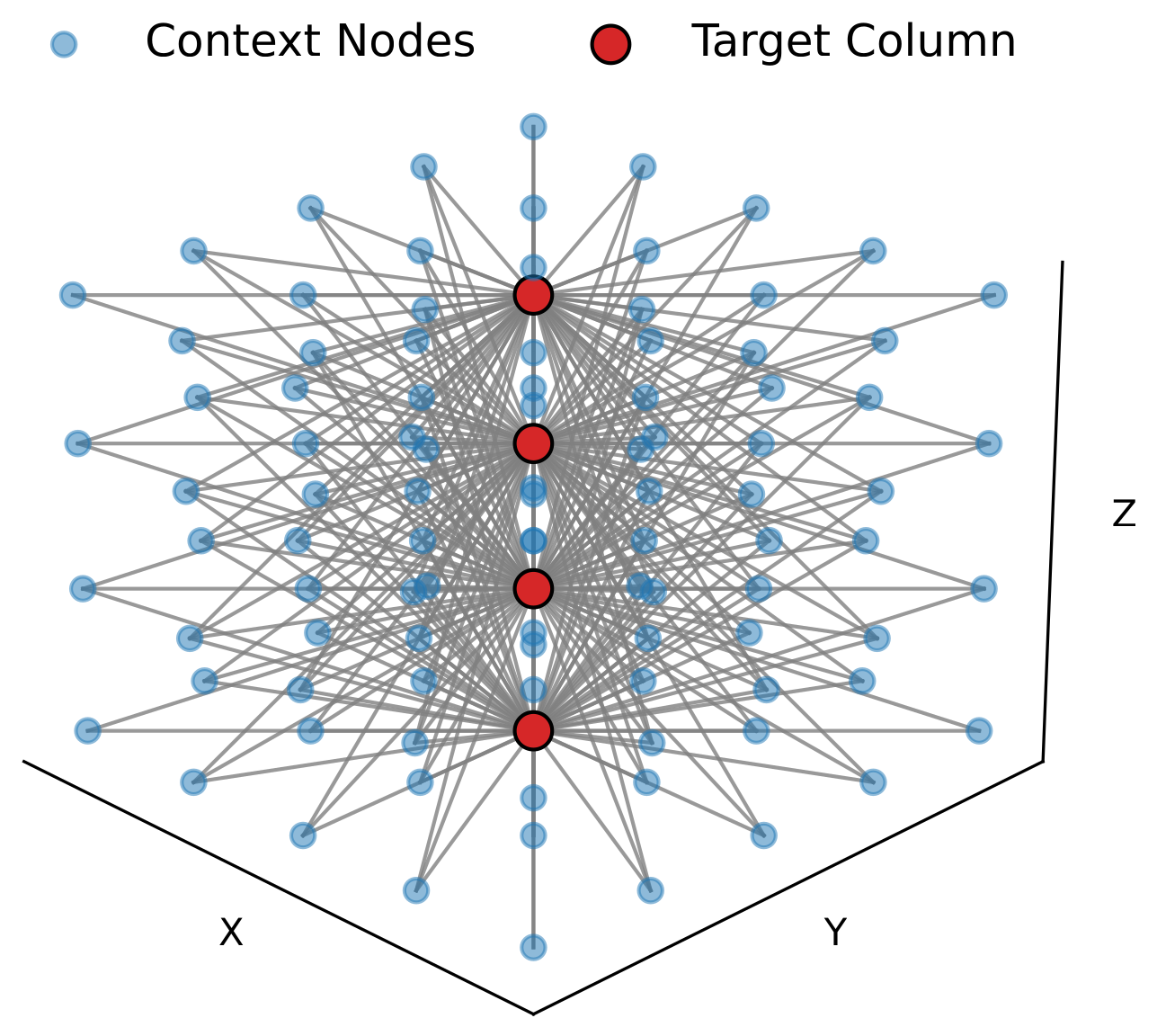
Schematic of the graph topology of the 3D surrogate: a 5 by 5 by 4 grid of context nodes (blue) linked to the target column in its centre (red).
Machine learning
Accelerating the expensive part

Non-LTE synthesis is slow because it is iterative and non-local. An atmosphere is a graph and the coupling is between neighbours — so a graph neural network learns the mapping once and evaluates it cheaply forever after. Two papers: general synthesis & inversion, then full 3D.
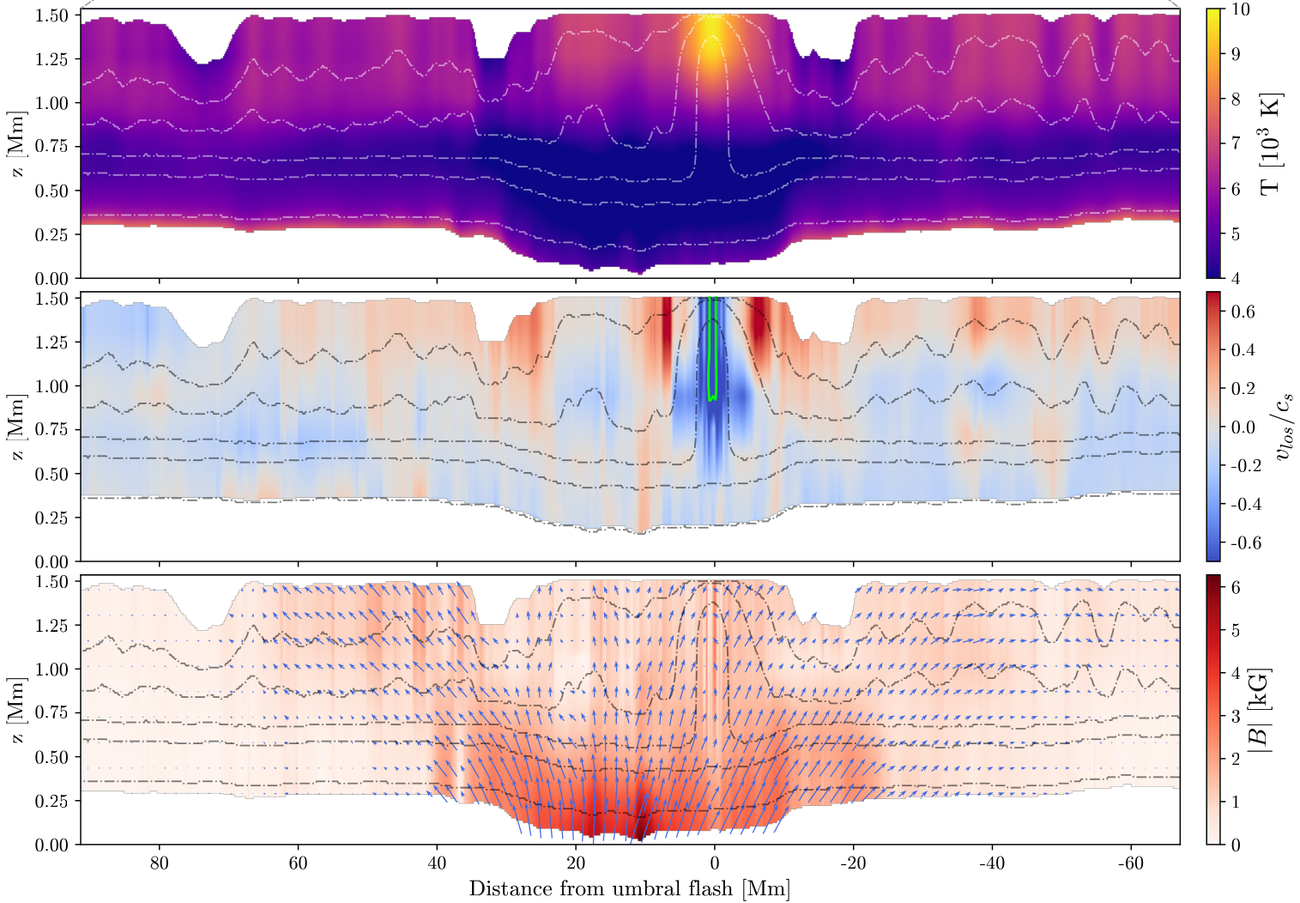
graphnet_nlte · ApJ 2022 · A&A 2026
Height cuts through the sunspot atmosphere, 0 to 1.5 Mm, against distance from an umbral flash: temperature, line-of-sight velocity over the sound speed, and field strength with arrows for the field direction.
Observations
Sunspot structure

Stokes inversions of sunspots under magnetohydrostatic equilibrium and non-LTE, connecting what is measured in the photosphere to what happens in the chromosphere above it.
A&A 2026
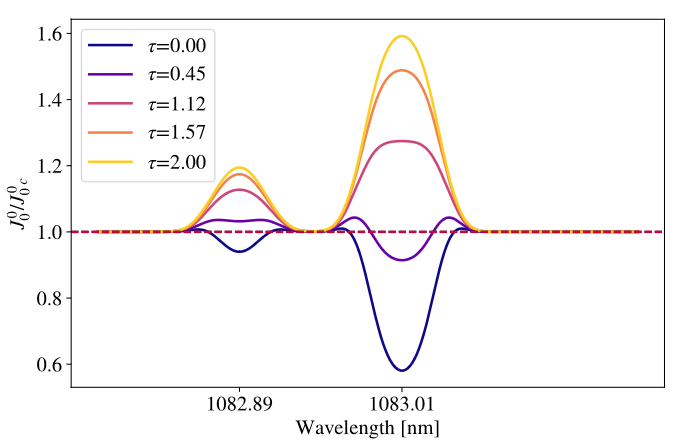
The radiation-field quantity J⁰₀ across the He I 10830 Å triplet, 1082.89 and 1083.01 nm, relative to its continuum value, for τ from 0 to 2: below the continuum at τ = 0 and up to 60% above it at τ = 2.
Diagnostics
The He I 10830 Å line

Its diagnostics depend on radiative transfer and the differential illumination of the atoms — which is what makes it a useful probe, and what makes it easy to misinterpret with a model that is too simple.

A&A 2023 · SPW10 talk

Papers, in plain English

7 refereed + 1 in preparation · from ORCID
2026Accelerating 3D non-LTE synthesis with graph neural networksVicente Arévalo, A.; Asensio Ramos, A.; Díaz Baso, C. J.Astronomy & Astrophysics, 710, A256Scales the GNN surrogate from 1D columns to full 3D atmospheres, so a simulation that took a cluster now takes a GPU.MLFirst author 2026Chromospheric and photospheric properties of sunspots from Stokes inversions under MHS and non-LTEVicente Arévalo, A.; Borrero, J. M.; Milić, I.; Pastor Yabar, A.; Kontogiannis, I.; Pietrow, A. G. M.Astronomy & Astrophysics, 708, A351Fits two layers of a sunspot at once with a physically consistent model, instead of treating each layer as if the other did not exist.ObservationsFirst author 2025The uncertainty of magnetic fields in 3D non-local thermodynamic equilibrium inversionsŠtěpán, J.; del Pino Alemán, T.; Vicente Arévalo, A.Astronomy & Astrophysics, 699, A73How much can you trust a 3D magnetic-field map? Puts error bars on the answer — inference, not just fitting.3D inferenceCo-author 2023First Metis Detection of the Helium D3 Line Polarization in a Large Eruptive ProminenceHeinzel, P. et al. (27 authors incl. Vicente Arévalo, A.)The Astrophysical Journal Letters, 957, L10Space-telescope first: polarised helium light from an erupting prominence, seen by Solar Orbiter's Metis coronagraph.ObservationsCo-author 2023The He I 10830 Å line: radiative transfer and differential illumination effectsVicente Arévalo, A.; Štěpán, J.; del Pino Alemán, T.; Martínez González, M. J.Astronomy & Astrophysics, 675, A45Shows when the standard shortcut for interpreting this line breaks — and how badly — so measurements built on it can be trusted or corrected.DiagnosticsFirst author 2022Accelerating Non-LTE Synthesis and Inversions with Graph NetworksVicente Arévalo, A.; Asensio Ramos, A.; Esteban Pozuelo, S.The Astrophysical Journal, 928, 101First use of graph neural networks as a drop-in replacement for an iterative physics solver; orders of magnitude faster.MLFirst author 2020Explaining the chemical trajectories of accreted and in-situ halo stars of the Milky WayBrook, C. B.; Kawata, D.; Gibson, B. K.; Gallart, C.; Vicente, A.Monthly Notices of the Royal Astronomical Society, 495, 2645-2651Uses cosmological simulations to tell which stars in our galaxy were born here and which were captured from others.SimulationCo-author
in prep.3D reconstruction of a prominence's magnetic fieldVicente Arévalo, A.; del Pino Alemán, T.; Martínez González, M.In preparation (ApJ Letters)The first fully 3D, non-LTE reconstruction of a solar prominence: geometry along the line of sight and field orientation without the 180° ambiguity.3D inferenceFirst author

Software

Research code that exists because a paper needed something that did not exist yet. Other repositories at github.com/andreuva.

POLARIS
C++ · collaborative

Three-dimensional non-LTE spectropolarimetric inversion. Treats atomic level populations and the radiation field as free parameters and imposes their consistency within one global minimisation — which is what makes a fully 3D inversion tractable at all. Used for the prominence reconstruction. A collaborative code: I lead its statistical-equilibrium solver.

Inverse problems · large-scale optimisation · HPC
FIRTEZ-NLTE ↗
Fortran · collaborative

FIRTEZ is a Stokes inversion code that works on a geometrical height scale and can impose magnetohydrostatic equilibrium. Its non-LTE version adds a Fortran solver for the multi-level statistical equilibrium (MALI with a short-characteristics formal solver), verified against my Python prototype and coupled to the inversion. A collaborative code with Juan Manuel Borrero: I develop the non-LTE version.

Inverse problems · non-LTE · MHS equilibrium
graphnet_nlte ↗
PyTorch · PyG

Graph neural networks that learn the non-LTE synthesis problem, so the expensive iterative part can be evaluated cheaply once trained. Behind the two acceleration papers.

Surrogate modelling · GNNs · GPU training

Talks

  • 2026

    3D graph neural networks for non-LTE synthesis

    European Astronomical Society annual meeting, Lausanne

  • 2026

    Non-LTE inversions of an umbral flash with magnetohydrostatic coupling

    European Astronomical Society annual meeting, Lausanne

  • 2026Invited

    Accelerating 3D solar atmosphere modelling with graph neural networks

    Guest lecture, ELLIS Unit Freiburg

  • 2026

    The next generation of modelling and observing techniques for the lower solar atmosphere

    Royal Astronomical Society meeting, London

  • 2025

    3D inversion of a solar prominence

    Solar Polarization Workshop SPW11, Prague

  • 2024Invited

    Round table on artificial intelligence

    COEFIS XVI, Universidad de La Laguna

  • 2023

    Introduction to artificial intelligence

    COEFIS XV, Universidad de La Laguna

  • 2022

    Formation of the polarized solar He I 10830 Å line

    Solar Polarization Workshop SPW10, Kyoto

  • 2022

    Accelerating non-LTE synthesis and inversions with graph neural networks

    European Astronomical Society annual meeting, Valencia

  • 2023Attended

    NLTE Workshop

    Porto

© 2026 Andrés Vicente Arévalo · Freiburg, Germany

 
  • ORCID

  • GitHub

  • [email protected]